
Inside Africa’s Sync Licensing Industry — If It Has One

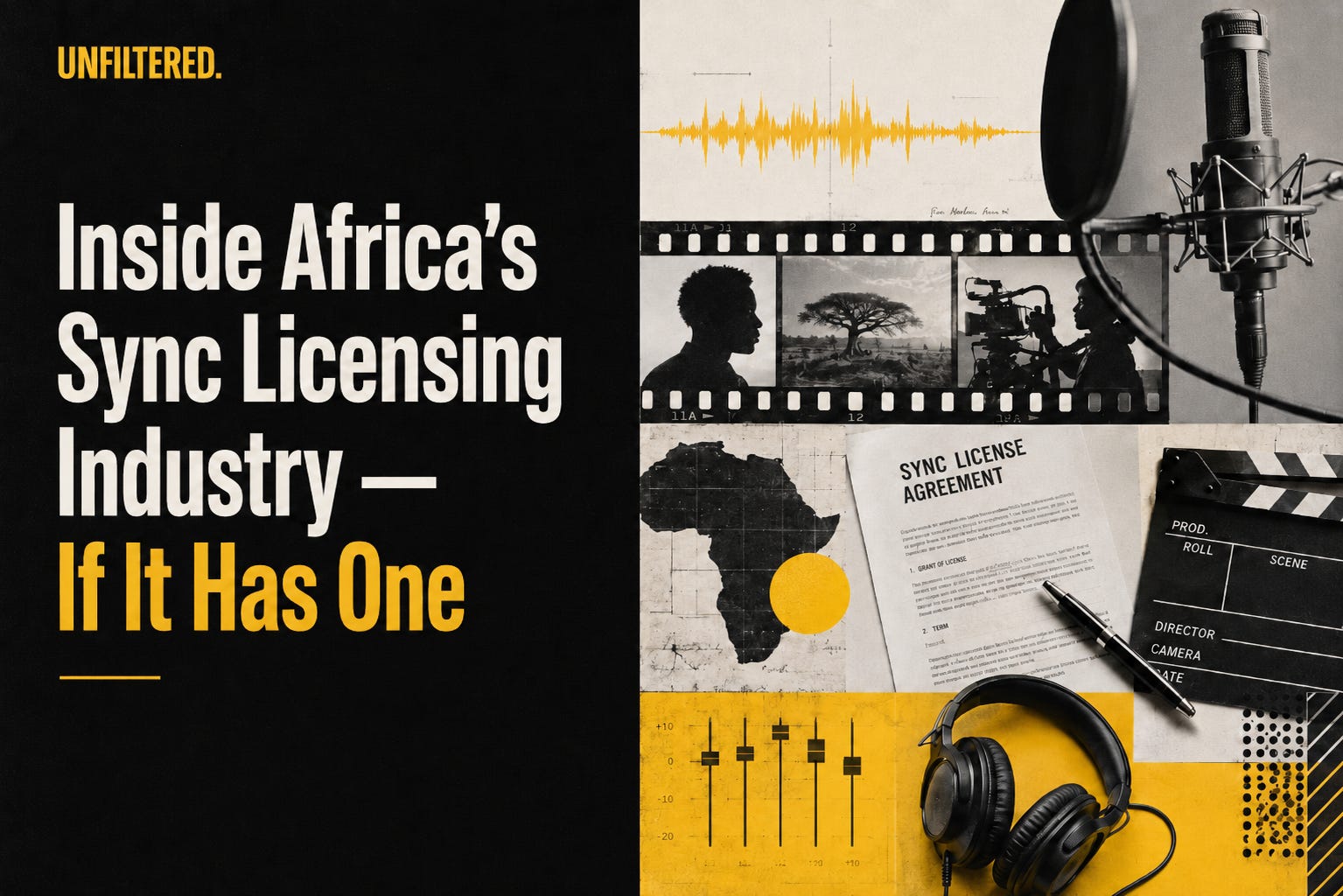
In recent news, Nigerian filmmaker and music video director Dami Twitch said Nollywood producers can no longer casually use Afrobeats songs in films without proper clearance.
One major reason he pointed to is that many artists now have publishing and distribution deals, including deals involving foreign companies. That means the rights around their music are more structured, and in many cases, more expensive or complicated to access.
This is good.
African artists should get paid what is due them.
However, if Nollywood producers are really struggling to afford these songs for their films, then an argument can be made that African filmmakers are underfunded or under-resourced. Another argument can be made that the use of those songs has simply become too expensive.
Both arguments may be true, but they only scratch the surface.
The bigger and deeper issue is that Africa still has an underdeveloped sync licensing industry.
This is a fact, yet it is one that still surprises me.
We have so much music and so much talent. We have the films, Nollywood especially. We have commercials, series, documentaries, digital content, trailers, games and campaigns that need music.
What we do not have enough of is the professional middle layer that connects these industries properly.
That layer is sync.
Sync licensing is what allows music to be legally used in visual media. It is what makes it possible for a song to appear in a film, a series, a bank commercial, a sports campaign, a video game, a documentary, a trailer or a social impact campaign.
In properly structured creative markets, this is an entire business.
But the fact that ours is still largely unstructured may also be one of the opportunity zones for Africa.
Where are the music supervisors who understand story, mood, culture, budget and rights? Where are the publishers who know how to package catalogues for film and advertising? Where are the sync agents who pitch music for screen opportunities? Where are the libraries with pre-cleared African songs? Where are the African composers creating original music for screen? I bet we have a lot.
Then there are the rate cards, clearance systems, contracts and professionals who know how to negotiate between the creative ambition of a production and the commercial value of a song.
In much of Africa, unfortunately, this entire system is still too weak.
And because it is weak, everybody loses something.
Filmmakers struggle to pay composers to create original music for their films. They also struggle to clear existing music they want to use. In some cases I have personally experienced, producers use music without proper approvals from the original creators, not always intentionally, but because they either do not know how clearance works or find the process confusing.
African artists are missing placement opportunities. Young musicians do not know that their catalogues have the potential to earn beyond streams and shows. Film producers do not always budget properly for music. It is mostly an afterthought. Composers are underused. Music supervisors are barely visible as an actual career path.
Sync is an afterthought here when it should be a serious revenue engine.
Maybe Afrobeats musicians in Nigeria are beginning to see it as such, hence the decision to structure their music rights properly.
Nonetheless, Africa’s creative economy may be missing the bigger opportunity: the connection between sound and screen.
A song placed in the right film scene can travel so much further than a playlist push. Thank the heavens for Shazam.
A strong soundtrack can make a series or show memorable. A video game can introduce African music to audiences who may never discover it through radio or streaming.
We have already seen hints of this.
Mr Eazi released “Attention” for F1: The Movie. Ghana’s Bisa Kdei had his song “Asew Me Nie” featured in the Netflix holiday film Jingle Jangle: A Christmas Journey, a Hollywood production that also featured music associated with John Legend and Usher.
These are not small moments.
They show what can happen when African music travels through global screen platforms. The songs gain visibility. The artists gain more cultural presence. The music can earn beyond the normal streaming cycle. More importantly, the sound of a country enters the memory of a wider audience.
I know not every artist will tour internationally, go viral or have their catalogue generate huge streaming revenue. But songs can live in films, commercials, series, campaigns and games if they are properly prepared, registered, pitched and cleared.
When I started my entertainment marketing agency, PR369 Comms, sync licensing was one of the offerings I intended to have because, I saw the gap.
I researched, started reading books and hoped to find living examples of sync agents I could learn from in my home country, Ghana.
But I could not find any.
I had to resort to watching YouTube videos and signing up for online courses. Those helped with knowledge, but honestly, I still did not know what to do with that knowledge.
Maybe one of you out there can advise or lead me to someone who can mentor me in that direction.
Anyway, the point is that sync can become another serious income stream, and artists and their teams need to think differently about their music.
It also requires filmmakers to think differently.
Music in film is not decoration. It is not the last thing you look for when the edit is almost done and the budget is finished. Music must be part of the development and production conversation.
If a film wants to carry a particular sound, that sound has to be budgeted for. And if a producer cannot afford a major song, there should be other pathways: emerging artists, original composition, pre-cleared catalogues, music libraries or direct partnerships with rights holders.
This is where Africa needs more structure.
What We Need
We need more sync agents and music supervisors.
We need African music libraries and more publishers actively pitching African catalogues for film, television, games and advertising.
We need more education for artists, producers, managers, filmmakers and agencies.
We need clearer licensing systems.
We need film funds and production budgets to include music as a serious line item.
We need entertainment lawyers and law firms, copyright offices and collecting societies on the continent to become more useful to the creative industries they claim to serve.
More importantly, we need to stop treating sync like an advanced conversation reserved for global markets.
It is not.
Sync matters in Africa because our visual culture is growing. The more we produce for screens, the more music those screens will need.
Whether African music will be properly positioned to benefit from that demand, I do not know.
Right now, too many opportunities are passing us by because the industry is not organized enough.
I have my own small sync story.
One of Africa’s top filmmakers once contacted me to make music for his show on Netflix. I was excited about the opportunity, but because of distance, I could not go to the music studios he had partnerships with in his home country. So he gave me the opportunity to find a music producer or composer in Ghana.
Unfortunately, it was a struggle to find a reliable one.
And that is how I lost that opportunity.
A filmmaker somewhere wants a song but does not know who to contact. A brand may need music but choose a generic stock track because licensing local music feels complicated. An artist may have the perfect song for a scene but no one is pitching it. A producer may avoid clearance entirely because they assume it is too expensive. A composer may be ready to score films but has no real bridge to directors and producers.
This is an infrastructure problem.
And this is why the Nollywood and Afrobeats conversation Dami Twitch commented on matters.
It is not simply about whether Nollywood can afford Afrobeats. It is about whether African music and African screen industries are ready to build the systems required to work together at scale.
If we are not, then we may keep celebrating global visibility while missing the business opportunities sitting right inside our own ecosystem.
Africa has enough hit songs.
Africa needs the systems that allow those songs to move.
We need music infrastructure that serves the film industry.
Our entertainment industry will not only be built by music or film alone, but by the bridges between them.
Sync licensing is one of those bridges.
Written by: Philippa Bentuma Arthur
Bentuma Arthur is a Cultural Strategist, Curator & Singer. She is the founder of PR369 Comms; a strategic communications & entertainment marketing company in Ghana
.